Reform and Investiture1046-1198
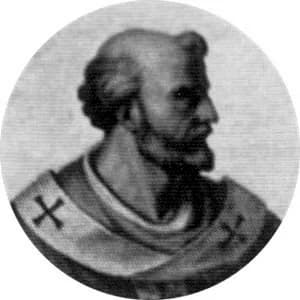
Innocent II
Elected in a hurry by half the cardinals, he won an eight-year schism by leaving Rome and letting Bernard of Clairvaux argue for him.
Pope no. 1641130-1143
On the morning Honorius II died, a minority of the cardinals elected Gregorio Papareschi as Innocent II in a fortified monastery, and by the afternoon the majority had elected Pietro Pierleoni as Anacletus II in Saint Mark's. Both elections were irregular. Anacletus had the numbers, the money and the Roman families; Innocent had almost nothing except the reforming party's respect.
Within weeks Innocent was driven out of Rome and took ship for France, and there the schism was decided, not by law but by persuasion. Bernard of Clairvaux declared for him and spent two years touring the courts: France, England, Germany, the Empire and eventually the reluctant princes of Italy came over. That the abbot of a Cistercian house could effectively choose the pope of the Western church says a good deal about where authority had migrated.
Anacletus held Rome until his death in 1138, propped up by Roger II of Sicily, whom he had crowned king in exchange. Only then could Innocent return, and he settled the affair at the Second Lateran Council in 1139, which annulled Anacletus's ordinations, condemned clerical marriage as invalid rather than merely illicit, and outlawed the crossbow in wars between Christians.
He was less successful in the field. Roger II ambushed and captured him at Galluccio in 1139, and released him only after Innocent confirmed the Sicilian kingship he had just condemned. He died in 1143 with the Roman commune in open revolt against him.
A full essay on this pope is in preparation. The facts and summary above are complete and sourced.
Sources
- J. N. D. Kelly and Michael Walsh, The Oxford Dictionary of Popes (2010)
- Eamon Duffy, Saints and Sinners: A History of the Popes (2014)
- I. S. Robinson, The Papacy 1073-1198: Continuity and Innovation (1990)
- Colin Morris, The Papal Monarchy: The Western Church from 1050 to 1250 (1989)
- Further reading: Wikipedia