The Iron Century903-1046
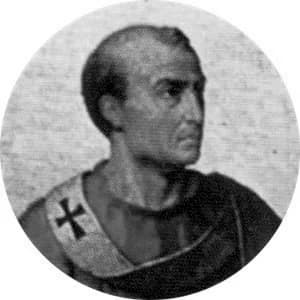
Gregory VI
The honest man who bought the papacy from his godson Benedict IX, welcomed by the reformers, resigned at Sutri; Hildebrand went with him.
Pope no. 1481045-1046
John Gratian was archpriest of Saint John at the Latin Gate, a Roman of good reputation and some learning, and Benedict IX's godfather. On 1 May 1045 Benedict, restored for six weeks and tired of the office, resigned it to him for a large sum of silver, which Gratian paid; the sources say one thousand pounds or two. He was consecrated on 5 May as Gregory VI. The reformers were relieved: Peter Damian wrote to congratulate him that the dove had returned to the ark, and a young Roman cleric named Hildebrand joined his household as chaplain. Whether Gratian thought the payment a purchase or a settlement with a departing pope is not recorded; the reformers decided for him.
Henry took him to Germany, and he died at Cologne in 1047, probably late in the year. Hildebrand went with him and came back after his death to serve Leo IX, and when Hildebrand became pope in 1073 he took the name Gregory VII, which the reformers understood as a verdict: the man who had bought the papacy from a Tusculan to save it had been, in his chaplain's eyes, a true pope. Sutri had ended the Iron Century by treating him as a false one, and the reform that followed was built on both judgments at once.
A full essay on this pope is in preparation. The facts and summary above are complete and sourced.
Sources
- J. N. D. Kelly and Michael Walsh, The Oxford Dictionary of Popes (2010)
- Eamon Duffy, Saints and Sinners: A History of the Popes (2014)
- Uta-Renate Blumenthal, The Investiture Controversy: Church and Monarchy from the Ninth to the Twelfth Century (1988)
- Philippe Levillain (ed.), The Papacy: An Encyclopedia (2002)
- Further reading: Wikipedia