The Iron Century903-1046
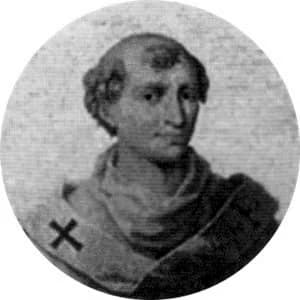
Benedict IX
Pope at twenty, driven out, restored, sold the office to his godfather, deposed at Sutri, and back once more: the Iron Century's last word.
Pope no. 1451032-1044, 1045, 1047-1048
Benedict IX is the only man who has been pope three times, and the only one generally agreed to have sold the office. He was Theophylact, a son of Count Alberic III of Tusculum, and he was elected in October 1032, on his uncle John XIX's death, because his father paid for it. He was about twenty. He reigned twelve years, in a manner Rome's chroniclers described with fresh vocabulary, until the city rose in September 1044 and drove him out; the Romans elected the bishop of Sabina as Sylvester III, and Benedict's brothers threw Sylvester out in March 1045 and brought Theophylact back. Six weeks later he resigned, having agreed with his godfather John Gratian, archpriest of Saint John at the Latin Gate, that Gratian would become pope and pay him a large sum of silver; Gratian became Gregory VI, and the reformers, who thought him an honest man, welcomed him. By 1046 three men had claims, and the emperor Henry III, coming for his crown, settled them all: Sylvester and Gregory at the synod of Sutri in December, Benedict at Rome on Christmas Eve, and a Saxon bishop was consecrated Clement II the next day. When Clement died in October 1047 Benedict took the Lateran a third time and held it for eight months, until the marquis of Tuscany drove him out for Henry's next pope. He was excommunicated for ignoring a summons in 1049 and died, by the tradition of the abbey where he is buried, a penitent.
The three reigns are counted, by the convention Cathedra follows, as pontificates 145, 147, and 150 of one man. His story is the reason the numbering has to explain itself, and the reason the eleventh century decided that the way popes were made had to change.
Tusculum
The counts of Tusculum, on the fortified hill above Frascati, were the descendants of Theophylact and Marozia through Alberic II, and for three generations they treated the papacy as an inheritance. Alberic's son Gregory took the title of count; Gregory's sons became Benedict VIII in 1012 and John XIX in 1024, while a third son, Alberic III, held the city as consul and senator; and when John XIX died Alberic bought the election for his own son Theophylact, who was consecrated on 21 October 1032.
Twelve years
What he did in twelve years is recorded chiefly by his enemies, who wrote after 1046. Peter Damian called his life so foul that it should not be described; Bonizo of Sutri and the monks of Monte Cassino accused him of murders, adulteries, and worse; a later pope, Victor III, who had known Rome in the 1040s, shuddered to tell it. The specifics are few, and the sources had a reform to justify. What the documents show is a Tusculan pope conducting his family's business. He held synods, deposed and restored bishops, and quarreled with Aribert of Milan at the emperor's request; he received Conrad II in Rome in 1038 and traveled with him; he canonized Simeon of Trier in 1042; he confirmed privileges for Cluny and for the monasteries of Italy as his uncles had. A Roman rising drove him out briefly in 1036 and Conrad restored him. In September 1044 a second rising, led by the Crescentii of the Sabina and the factions the Tusculans had excluded, drove him out again, and this time the Romans elected another pope.
How foul, how vile, how execrable his life was, I shudder to tell.
Sylvester and the sale
The bishop of Sabina, John, was elected on 20 January 1045 as Sylvester III and held the Lateran for seven weeks. Benedict's brothers Gregory and Peter took the city back in March, and on 10 March Theophylact was pope again. He did not want to be. On 1 May 1045 he resigned in favor of his godfather John Gratian, a priest of good reputation whom the reformers respected, and Gratian paid him: the figure is given as a thousand pounds of silver by some sources and two thousand by others, and the reason for the resignation, in the only source that offers one, was that the pope wished to marry. Gratian was consecrated as Gregory VI on 5 May. Peter Damian wrote to congratulate him; a young cleric named Hildebrand became his chaplain; and Benedict withdrew to Tusculum, where he did not renounce his claim.
Sutri
Henry III came to Italy in the autumn of 1046 to be crowned emperor and found three men calling themselves pope, one of whom, Gregory, met him at Piacenza and was received with honor. Henry would accept none of them. At Sutri, north of Rome, on 20 December 1046, a synod under the king declared that Sylvester III had never been pope and sentenced him to a monastery, and heard Gregory VI confess that his office had been obtained by simony and lay it down; at Rome on 24 December another synod deposed Benedict IX in his absence. On Christmas Eve the bishop of Bamberg, Suidger, a Saxon, was elected, and on Christmas Day he was consecrated as Clement II and crowned Henry and Agnes emperor and empress in Saint Peter's. The Romans gave Henry the title of patrician and the right that went with it, to name the pope. Gregory VI went into exile at Cologne with Hildebrand and died there the next year.
The third reign
Clement II died at Pesaro on 9 October 1047 after ten months, and rumor said Benedict had poisoned him. Whether or not he had, he was ready: in November the Tusculans put him back in the Lateran, and he held it from 8 November 1047 for eight months while the Romans sent to Henry for a pope and Henry named Poppo, bishop of Brixen. Boniface of Tuscany, the strongest lord in Italy and no friend of the emperor, was ordered to install Poppo and at first refused; when Henry insisted, Boniface marched, drove Benedict out on 16 July 1048, and enthroned Poppo as Damasus II the next day. Damasus died three weeks later. Benedict never returned. Leo IX summoned him to a synod in 1049 to answer for simony and, when he did not come, excommunicated him.
The count
The Annuario Pontificio lists Benedict IX three times, and so does Cathedra: numbers 145, 147, and 150 of the succession are one man, and the numbering of the popes, which counts pontificates, has 267 of them for 265 men because of him. The convention is old, and it is honest about what happened: a Roman family held the papacy as property, lost it, bought it back, sold it, and took it again by force, and the list recorded every transfer. The reform that followed drew its program from his reign. Simony became the first sin the reformers attacked because a pope had committed it with the papacy itself; the election decree of 1059 gave the choice of pope to the cardinals because the Romans had shown what they did with it; and the chaplain who went into exile with the pope who had bought the office from Benedict came back as Gregory VII. The Iron Century ended with Theophylact of Tusculum, and the papacy that emerged from Sutri was built not to produce another.
Sources
- J. N. D. Kelly and Michael Walsh, The Oxford Dictionary of Popes (2010)
- Eamon Duffy, Saints and Sinners: A History of the Popes (2014)
- Chris Wickham, Medieval Rome: Stability and Crisis of a City, 900-1150 (2015)
- Uta-Renate Blumenthal, The Investiture Controversy: Church and Monarchy from the Ninth to the Twelfth Century (1988)
- John France (trans.), Rodulfus Glaber: The Five Books of the Histories (1989)
- Philippe Levillain (ed.), The Papacy: An Encyclopedia (2002)
- Further reading: Wikipedia