Reform and Investiture1046-1198
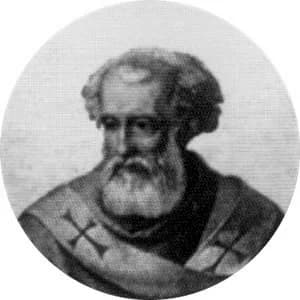
Gelasius II
Seized by a Roman baron on the day of his election, driven out by an emperor, and dead in a Burgundian abbey within the year.
Pope no. 1611118-1119
John of Gaeta had been a monk of Monte Cassino and then, for over thirty years, chancellor of the Roman church. In that office he did something quietly permanent: he imposed on papal letters the rhythmic prose cadences known as the cursus, giving the chancery a house style so distinctive that forgeries could afterwards be detected by ear.
His pontificate was a chase. He was elected at the monastery of Palladium on 24 January 1118, and Cencio Frangipane broke in with armed men the same day, seized the new pope by the throat and dragged him off in chains to a family tower. The Roman crowd forced his release. Six weeks later Henry V arrived in the city, and Gelasius fled by sea to Gaeta; the emperor installed the archbishop of Braga as the antipope Gregory VIII.
Gelasius came back to Rome in July, was attacked again by the Frangipani while saying mass in Santa Prassede, and got out of the city on a borrowed horse, riding through a cornfield with his household running behind him. He crossed to France, consecrated churches at Pisa and Marseille on the way, and reached Cluny in November.
He died there on 29 January 1119, in the habit of the order, and was buried in the abbey church. The cardinals with him, unable to reach Rome, elected the archbishop of Vienne in his place four days later.
A full essay on this pope is in preparation. The facts and summary above are complete and sourced.
Sources
- J. N. D. Kelly and Michael Walsh, The Oxford Dictionary of Popes (2010)
- Eamon Duffy, Saints and Sinners: A History of the Popes (2014)
- I. S. Robinson, The Papacy 1073-1198: Continuity and Innovation (1990)
- Further reading: Wikipedia