The Age of Persecution99-311
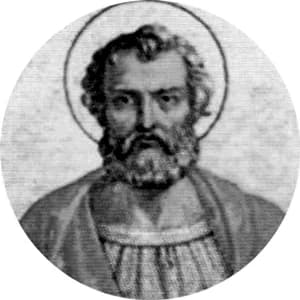
Saint Felix I
The pope in whose reign a pagan emperor, asked who owned a church in Antioch, answered: whoever the bishops of Italy and Rome recognize.
Pope no. 26269-274
Felix, a Roman and the son of Constantius according to the Liber Pontificalis, was elected on 5 January 269 and reigned for six years in which nothing is recorded of him except a letter he did not write and a ruling he did not seek. The letter, addressed to Bishop Maximus of Alexandria and quoted at the Council of Ephesus in 431 as proof that Rome had always taught the true doctrine of Christ's two natures, is a fifth-century forgery. The ruling is real and matters more.
In 268 a synod at Antioch had deposed its bishop, Paul of Samosata, for heresy, and Paul, who enjoyed the protection of Queen Zenobia of Palmyra, refused to hand over the church building. When Aurelian reconquered the East in 272 the Christians of Antioch appealed to him, and the pagan emperor, Eusebius records, "decided the matter most equitably, ordering the building to be given to those to whom the bishops of Italy and of the city of Rome should adjudge it." Paul was thrown out. It was the first time an emperor had taken sides in a Christian quarrel, and the side he chose was defined by communion with Rome. Nobody had told Aurelian that this was how the church worked; he had simply observed it.
Aurelian, who had been preparing an edict against the Christians when he was murdered in 275, would not have seen the irony. Felix had died on 30 December 274, a few months before him, and was buried in the catacomb of Callixtus.
A full essay on this pope is in preparation. The facts and summary above are complete and sourced.