The Age of Persecution99-311
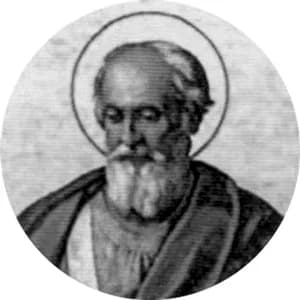
Saint Eusebius
Four months, a riot over the lapsed, and a death in Sicilian exile: the last pope of the persecutions, remembered in verse by Damasus.
Pope no. 31309
Eusebius, a Greek and a physician's son according to the Liber Pontificalis, was elected on 18 April 309 and inherited the quarrel that had destroyed Marcellus. Rome's Christians were still split over the thousands who had sacrificed under Diocletian six years before: the bishop held, as Cornelius and Callixtus had held, that they could return after penance, while a faction led by a certain Heraclius demanded that they be received at once, without it. Damasus, who wrote Eusebius's epitaph half a century later, put the whole reign in six lines: Heraclius forbade the lapsed to grieve for their sins, Eusebius taught them to weep; the people divided, and there followed "sedition, slaughter, war, discord, strife," until the tyrant exiled both leaders. The tyrant was Maxentius, and the exile was Sicily, where Eusebius died, after four months in office, on 17 August.
Rome brought him home. His body was laid in the catacomb of Callixtus, in a chamber near the papal crypt that still carries his name, and Damasus's verses were cut in marble above it, calling him bishop and martyr; the calendar of 354 does not. The Roman church then waited nearly two years, until 2 July 311, to elect Miltiades, by which time Galerius had signed the edict admitting that the persecution had failed and permitting Christians "to exist again." Eusebius is the last pope of the era in which the office was, in law, a capital crime.
A full essay on this pope is in preparation. The facts and summary above are complete and sourced.
Sources
- J. N. D. Kelly and Michael Walsh, The Oxford Dictionary of Popes (2010)
- Dennis Trout, Damasus of Rome: The Epigraphic Poetry (2015)
- Raymond Davis (trans.), The Book of Pontiffs (Liber Pontificalis) (2000)
- Further reading: Wikipedia