The Imperial Church311-483
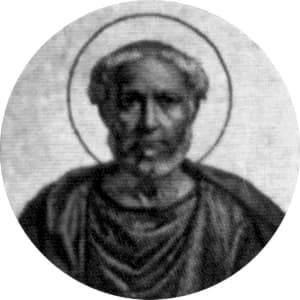
Saint Damasus I
Elected in a riot that left 137 dead, he made Rome a city of shrines, set Jerome on the Bible, and named his chair the apostolic see.
Pope no. 37366-384
Damasus came to the chair of Peter over a hundred and thirty-seven corpses and left it as the most powerful bishop in the world. The first fact was held against him for the rest of his life; the second was his own work. In eighteen years he turned the catacombs into a pilgrim's Rome of carved marble and lamplight, put the martyrs at the center of the city's identity, gave the Roman church a chancery that wrote like the imperial one, secured from Theodosius an edict naming his faith the empire's, and hired the most learned man in Latin Christendom as his secretary and set him to work on the Bible. He was also, his enemies said, a dandy who tickled the ears of matrons, and a pagan senator joked that he would convert tomorrow if they made him bishop of Rome.
Both pictures are true, and they describe the same transformation. Under Damasus the bishop of Rome stopped being the leader of a favored community and became a Roman magnate with a court, an income, a building program, and a claim, which he was the first to state in these words, to preside over the apostolic see.
The riot of 366
Damasus was about sixty when Liberius died on 24 September 366, a deacon born in Rome to a family from Spain whose father had risen through the clergy of the church of Saint Lawrence. He had gone into exile with Liberius in 355 and come home early to serve under the intruded Felix, which the Liberian loyalists never forgave. When the see fell vacant they elected the deacon Ursinus and had him consecrated in the Julian basilica in Trastevere; Damasus's supporters elected him in the church of Lucina, and on 1 October three bishops consecrated him in the Lateran. Rome had two popes again, and this time neither side waited for the emperor.
Damasus, the sources agree, moved first. He hired the men who could be hired, charioteers, gravediggers, the crowds of the arena, and stormed the Julian basilica; the prefect exiled Ursinus, and his followers occupied the Liberian basilica on the Esquiline. On 26 October Damasus's men broke in. Ammianus Marcellinus, a pagan officer with no side to take, counted the dead the next morning: one hundred and thirty-seven, in a church.
Valentinian I backed the winner. Ursinus was allowed home in 367, provoked more riots, and was banished again; his partisans kept up the fight for a decade, and in 371 a converted Jew named Isaac laid a charge of adultery against the pope before the prefect. Damasus was acquitted by the emperor and then by a synod of forty-four bishops in 378, which asked Gratian to rule that the bishop of Rome should be tried only by the emperor himself. The nickname stuck anyway. He was the ear-tickler of matrons, and the matrons, Jerome's ascetic friends among them, were the base of his support.
The city of the martyrs
What Damasus did with power was to dig. He went out along the roads to the catacombs, cleared the galleries, drained the water, opened light-wells and stairs, and at the tombs of the martyrs set up marble slabs cut with his own verses in a monumental lettering designed for him by the calligrapher Furius Dionysius Filocalus. Some sixty of the epigrams survive, in whole or in fragments, and they are the papacy's first sustained act of public writing: short, plain, insistent that here lay Sixtus, here Cornelius, here the anonymous crowd of the pious, here Peter and Paul had once been kept. Rome, which had no apostolic founder's grave to match Jerusalem's, was given a sacred landscape instead, and the pilgrims came.
Here, I confess, I, Damasus, wished to lay my bones; but I feared to disturb the holy ashes of the saints.
The building went on above ground too. He turned his family property near the Campus Martius into a church, the titulus Damasi, later San Lorenzo in Damaso, with an archive attached; he restored the cemetery church of Saint Lawrence and drained the site of Saint Peter's. And he took over the machinery of the city's memory. The calendar of 354, drawn by the same Filocalus, had already listed the bishops and martyrs of Rome by feast day; Damasus made the martyrs the church's aristocracy and himself their keeper.
The apostolic see
Theodosius, an orthodox Spaniard, became emperor in the East in 379, and on 27 February 380 issued from Thessalonica the edict that made Christianity the religion of the empire. It defined that religion by naming two bishops: "the faith which the divine apostle Peter delivered to the Romans, and which it is evident that the pontiff Damasus and Peter, bishop of Alexandria, follow." Damasus had done nothing to bring the edict about, but it put his name into law as the standard of orthodoxy, and he used it. The council Theodosius summoned to Constantinople in 381, which Damasus did not attend, gave the bishop of the new capital "the primacy of honor after the bishop of Rome, because Constantinople is New Rome." Damasus's answer came from a Roman synod in 382: the Roman church's primacy rested not on any council but on the words of Christ to Peter, and after Rome came Alexandria and Antioch, the sees Peter had founded or sent Mark to found. It was the first time a pope had ranked the churches of the world, and the first time the phrase "apostolic see," which Damasus's chancery had been using for years, was set against a rival's claim.
The claim came at a price in the East. Damasus backed the wrong candidate in the schism at Antioch, refused to recognize Basil of Caesarea's protégé, and kept the great Cappadocian waiting for years for answers; Basil's letters about "the arrogance of the West" are the first of a long series.
Jerome
In 382 a scholar from Dalmatia who had lived as a hermit in Syria, learned Hebrew, and quarreled with most of the East arrived in Rome as an adviser to the bishops attending Damasus's synod. Damasus kept him as his secretary. For three years Jerome drafted the pope's letters, answered his questions about scripture, taught the ascetic circle of aristocratic women who gathered around Marcella and Paula, and, at Damasus's request, began to revise the chaotic Latin translations of the Bible against the Greek. The Gospels were done by 384. The whole, finished in Bethlehem over the next twenty years, became the Vulgate, the Bible of the Latin church for eleven centuries and the reason a pope's secretary is the most-read translator in history.
Jerome later wrote that Damasus "had a fine talent for composing verses" and left the phrase to stand as praise or not. He also recorded that when Damasus died on 11 December 384, aged nearly eighty, "the whole city" had expected Jerome to succeed him, and that the election of Siricius drove him from Rome for good.
What he left
Damasus was buried, as his epigram promised, not in the papal crypt but with his mother and sister on the Via Ardeatina, in a small basilica of his own. The papacy he left was a different institution from the one he had seized. It owned a Rome of shrines and pilgrims; it wrote decretals that Siricius would turn into law; it ranked the churches of the world with itself at the head and said the ranking came from Christ; it had an emperor's edict with its bishop's name in it; and it had begun, through Jerome, to give the West its scripture. The riot of 366 was never forgotten, and Damasus is the rare saint whose canonization the sources let one argue with. But when Ammianus wrote that the bishopric of Rome was worth a fight, it was Damasus who had made it so.
Sources
- J. N. D. Kelly and Michael Walsh, The Oxford Dictionary of Popes (2010)
- Eamon Duffy, Saints and Sinners: A History of the Popes (2014)
- Dennis Trout, Damasus of Rome: The Epigraphic Poetry (2015)
- Ammianus Marcellinus, Res Gestae (The Later Roman Empire), Book 27 (390)
- Jerome, Letters (410) · link
- Raymond Davis (trans.), The Book of Pontiffs (Liber Pontificalis) (2000)
- Further reading: Wikipedia