The Age of Persecution99-311
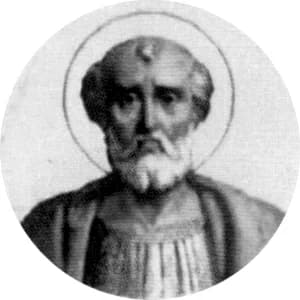
Saint Callixtus I
A slave and Sardinian convict who rose to the chair of Peter, forgave the sinners his rival would expel, and gave the catacombs his name.
Pope no. 16c. 217-c. 222
No pope before the twentieth century has a biography as detailed as Callixtus's, and no pope has one written by so determined an enemy. Nearly everything known about his life before he took the chair comes from Hippolytus, the most learned presbyter in Rome, who refused to accept his election, set himself up as bishop of a rival congregation, and wrote a long account of his opponent's career as a slave, a fraudulent banker, a brawler, and a convict, intended to prove that such a man could not be a bishop of anything. Read against its grain, the account describes something remarkable: a church in which a slave could rise to the top of the hierarchy in the capital of the empire, and in which the bishop's chair went to the practical man rather than the theologian.
What Callixtus did with the chair matters more than how he reached it. In five years he settled the shape of the Roman church's discipline for centuries, admitting to penance and communion sinners whom the rigorists wanted permanently outside, and he left his name on the cemetery along the Appian Way where his successors would be buried and where one of them would be killed. He is the first bishop of Rome after Peter whom the city's oldest calendar of martyrs lists among its own.
The slave of Carpophorus
Hippolytus's story begins in the household of Carpophorus, a Christian freedman in the service of the emperor, who owned a slave named Callixtus and, seeing that he had a head for money, set him up with a bank in the Piscina Publica district. Christians, including widows, deposited their savings with him on Carpophorus's reputation. The money was lost. Callixtus fled to Portus, boarded a ship, saw his master on the quay, and jumped into the sea; he was hauled out, brought home, and sent to the treadmill. The depositors, hoping to recover something, had him released, and he went to the synagogue on the Sabbath to demand repayment from Jewish debtors, or, Hippolytus says, to provoke a riot and get himself killed. He was arrested for disturbing the synagogue, flogged by the prefect Fuscianus as a Christian, and sent to the mines of Sardinia.
The mines were a death sentence deferred, and Callixtus was rescued from them by imperial favor. Around 190 Marcia, the Christian concubine of the emperor Commodus, asked Pope Victor for a list of the Christians in Sardinia so that she could have them freed. Victor supplied it and, according to Hippolytus, left Callixtus off it; the eunuch who carried the pardon included him anyway, at his own pleading. Back in Rome, an embarrassment to a bishop who had not wanted him, Callixtus was pensioned off to Antium on the coast with a monthly allowance. He was there for about ten years.
The deacon of the Appian Way
Victor's successor Zephyrinus recalled him, ordained him deacon, and, in Hippolytus's phrase, "set him over the cemetery." The phrase is the first reference to church property in Rome. Two miles down the Appian Way, on land somehow held for the community, Christians had begun digging galleries into the soft tufa to bury their dead in rows of shelves cut into the walls, and Callixtus administered it: the first common burial ground of the Roman church, a place where a poor believer could lie among the brethren rather than in a pauper's pit. It became the burial place of the bishops themselves; nine third-century popes were laid in one crypt there, and the whole complex still bears his name.
Hippolytus says Callixtus ran Zephyrinus as well as the cemetery, and that the bishop was too ignorant to notice. The church of the years around 210 was fighting over how to speak of God: teachers from Asia insisted that Father and Son were one person and that the Father had suffered on the cross, while Hippolytus insisted on two persons and thought anyone who hesitated a heretic. Zephyrinus, coached by Callixtus, produced formulas that kept both parties inside the church, which to Hippolytus was proof of duplicity. When Zephyrinus died in 217 the majority of the Roman clergy elected the deacon. Hippolytus and his supporters elected Hippolytus.
Bishop and rival
The schism lasted longer than the pontificate. Hippolytus led his own congregation through the reigns of Callixtus, Urban, and Pontian, and was finally reconciled only when he and Pontian were deported together to Sardinia in 235 and died there; the church buried them both as martyrs on the same day and put a statue of Hippolytus, listing his works, on the Via Tiburtina. He is the first man to be called an antipope, and he is a saint.
His charges against Callixtus were doctrinal and disciplinary. On doctrine, Callixtus excommunicated Sabellius, the leading teacher of the one-person view, which Hippolytus dismissed as a maneuver, and then taught that Father and Son were "one and the same Spirit," which Hippolytus called the same heresy in a new coat. On discipline, Callixtus admitted to penance and reconciliation Christians guilty of adultery and fornication, whom the rigorists held could never be readmitted; received back members of schismatic groups without penalty; allowed clergy who had married twice or three times to remain in office; and recognized as marriages the unions of free women with slaves or freedmen, which Roman law refused to recognize and which a Christian woman of rank could contract in no other way. He justified all of it from scripture: the ark of Noah had held unclean animals as well as clean, and the Lord had said to let the tares grow with the wheat until the harvest.
Rome divided along a line that would run through every later crisis: a church of the pure, which expelled the fallen to protect its holiness, and a church of the penitent, which kept them and worked out the terms. Callixtus's Rome chose the second, and every later argument about who could be forgiven, from the lapsed of the Decian persecution to the divorced of the twentieth century, would be conducted on the ground he had marked out.
Death in Trastevere
Callixtus died in 222, in the first year of Alexander Severus, an emperor friendly to Christians, which rules out an official execution. A fifth-century passion story tells what the Roman church remembered or invented: a riot in Trastevere, the pope thrown from a window of his house and dropped down a well, his body hidden by a priest and buried in haste on the Via Aurelia. The burial place, at least, is confirmed. He was not laid in the cemetery he had built on the Appian Way but in the small catacomb of Calepodius on the Aurelian road, which suggests that his body could not be carried across the city, and the Roman calendar of 354 lists him under 14 October among the martyrs, the earliest pope after Peter to appear there.
Trastevere also holds his monument. The Liber Pontificalis says Callixtus built a church there, and the biography of Alexander Severus in the Historia Augusta preserves a dispute between the Christians and the tavern-keepers over a piece of ground, which the emperor settled in favor of the Christians.
It was better that God be worshipped there in whatever manner than that the place be handed over to the tavern-keepers.
The site is the basilica of Santa Maria in Trastevere, rebuilt in the twelfth century, where the relics of Callixtus lie under the high altar to which Gregory IV moved them in the ninth.
What the rival could not prevent
Hippolytus wrote the Refutation to destroy Callixtus's reputation, and instead it preserved him. Without it he would be a name in the list like Urban or Eleutherius. Because of it he is the one early pope whose social origins, career, and policy can be seen in detail, and the picture that survives the malice is of a church already able to lift a slave to its head and already disposed, in its head's own words, to keep the tares with the wheat. The cemetery on the Appian Way was rediscovered in 1849 by the archaeologist Giovanni Battista de Rossi, who found a fragment of marble reading "NELIUS MARTYR" in a vineyard and, five years later, opened the crypt where Pontian, Anterus, Fabian, Lucius, and Eutychian still lay with their names in Greek on the wall. Pius IX, visiting, wept. De Rossi called it the little Vatican, and it is Callixtus's.
Sources
- J. N. D. Kelly and Michael Walsh, The Oxford Dictionary of Popes (2010)
- Eamon Duffy, Saints and Sinners: A History of the Popes (2014)
- Hippolytus of Rome, Refutation of All Heresies, Book IX (225) · link
- Peter Lampe, From Paul to Valentinus: Christians at Rome in the First Two Centuries (2003)
- Raymond Davis (trans.), The Book of Pontiffs (Liber Pontificalis) (2000)
- Further reading: Wikipedia