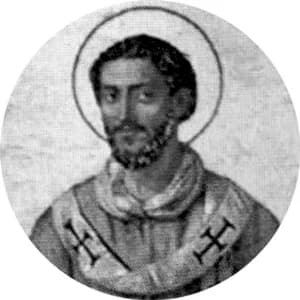
The Age of Persecution99-311
Saint Caius
Twelve years of peace on the eve of the storm: a Dalmatian pope, said to be Diocletian's kinsman, who set the ladder of clerical orders.
Pope no. 28283-296
Caius was elected on 17 December 283 and died on 22 April 296, and the twelve years between were the last in which a bishop of Rome could assume that the state would leave him alone. Diocletian, who took the purple in 284 and spent his first two decades restoring the empire, tolerated the church throughout them; Eusebius remembered Christians holding office at court and churches rising in every city. The Liber Pontificalis calls Caius a Dalmatian from Salona, the emperor's own home town, and a relative of Diocletian, a claim no earlier source makes and the compiler had every reason to invent.
Two things are attached to his name. The Liber Pontificalis says he decreed that a man must pass through the grades of doorkeeper, reader, exorcist, acolyte, subdeacon, deacon, and priest before he could be a bishop, the ladder of orders the Latin church kept until 1972; the ladder existed by the fourth century and the decree gave it a founder. And the same book says he assigned the districts of the city to the deacons, which Fabian had already done.
He was buried in the catacomb of Callixtus, in a chamber near the papal crypt, where his epitaph in Greek was found in 1849. A church dedicated to him on the Quirinal, said to stand on his house, was demolished in 1880 to make room for the ministry of war.
A full essay on this pope is in preparation. The facts and summary above are complete and sourced.