The Iron Century903-1046
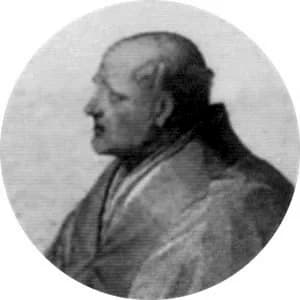
Benedict VII
A bishop of Sutri chosen after an antipope fled with the treasury, who kept the peace with Otto II for nine years and preached reform.
Pope no. 135974-983
Benedict was a Roman of the Theophylact line, son of David, and bishop of Sutri when the imperial envoy Sicco took Rome in the summer of 974 and found Benedict VI strangled and his murderer, Boniface VII, gone to Constantinople with the treasury. The Romans' first choice for the vacancy, Majolus of Cluny, refused it; Benedict was elected as a man both the emperor's party and the Crescentii could accept, and consecrated in October 974. He began with a synod that excommunicated Boniface, who came back in 980 while the pope was away, held Rome briefly, and fled again when Otto II came south. Otto stayed in Italy from 980 until his death, and for three years Benedict had an emperor in residence.
He used the peace for reform of a monastic kind. He supported Majolus and the Cluniac houses, restored Subiaco, and gave the monastery of Saints Boniface and Alexius on the Aventine the privileges that made it, under Otto III, a seminary of missionaries to the Slavs; in March 981, in Saint Peter's, with Otto beside him, he held a synod that forbade the sale of holy orders, the first Roman decree against simony in a century. He confirmed the archbishop of Trier's vicariate in Germany and gave the pallium to Dagobert of Bourges.
He died on 10 July 983, four months before the emperor, and Otto II chose his own chancellor to succeed him. It was the last quiet succession in Rome for a generation.
A full essay on this pope is in preparation. The facts and summary above are complete and sourced.
Sources
- J. N. D. Kelly and Michael Walsh, The Oxford Dictionary of Popes (2010)
- Eamon Duffy, Saints and Sinners: A History of the Popes (2014)
- Chris Wickham, Medieval Rome: Stability and Crisis of a City, 900-1150 (2015)
- Philippe Levillain (ed.), The Papacy: An Encyclopedia (2002)
- Further reading: Wikipedia