The Iron Century903-1046
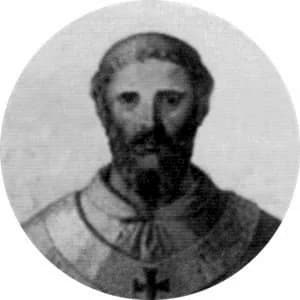
Benedict VI
Otto's confirmed pope, seized within a year of the emperor's death and strangled in Castel Sant'Angelo on the orders of an antipope.
Pope no. 134973-974
Benedict was a Roman, the son of a man named Hildebrand, and a cardinal deacon when John XIII died in September 972. He was elected soon afterward as the imperial party's candidate, but under the rule Otto I had imposed he could not be consecrated until the emperor's confirmation arrived from Germany, and it took four months: he was consecrated on 19 January 973. Otto I died on 7 May. His son Otto II, twenty-two and occupied with a war in Lorraine and a rising in Bavaria, could not come south, and the Roman nobility that the Ottos had hanged and exiled in 966 saw its chance. In June 974 Crescentius, a son of the younger Theodora and the head of the family that would run Rome for the next forty years, seized Benedict, shut him in Castel Sant'Angelo, and had the cardinal deacon Franco consecrated pope as Boniface VII.
Benedict VI's own acts are the ordinary privileges of an eighteen-month reign, for monasteries in Italy and Germany and for the see of Trier, whose archbishop he made his vicar. He is remembered for his death, the first of the Crescentian murders, and for what it showed about the settlement of 962: the emperor could make a pope from Germany but could not keep him alive from there. Otto II, when he finally came to Italy in 980, found the antipope back in the city and the Crescentii unpunished, and settled for a pope acceptable to both sides. Benedict was buried in Saint Peter's.
A full essay on this pope is in preparation. The facts and summary above are complete and sourced.
Sources
- J. N. D. Kelly and Michael Walsh, The Oxford Dictionary of Popes (2010)
- Eamon Duffy, Saints and Sinners: A History of the Popes (2014)
- Chris Wickham, Medieval Rome: Stability and Crisis of a City, 900-1150 (2015)
- Philippe Levillain (ed.), The Papacy: An Encyclopedia (2002)
- Further reading: Wikipedia