The Age of Persecution99-311
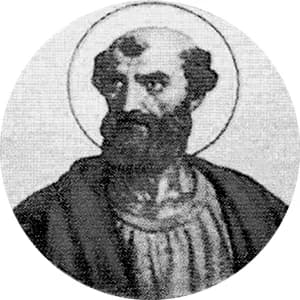
Saint Alexander I
A Roman of Trajan's reign, later confused with a martyr of the same name on the Via Nomentana and credited with rites he never knew.
Pope no. 6c. 107-c. 115
Eusebius gives Alexander ten years and the tenth year of Trajan for his accession; Irenaeus gives him the fifth place after the apostles; and that is where contemporary knowledge of him ends. The Liber Pontificalis calls him a Roman, the son of a man of the same name, and attaches to him two liturgical inventions that a sixth-century compiler could not resist: the insertion of the words of institution, the account of the Last Supper, into the canon of the Mass, and the blessing of water mixed with salt for sprinkling in homes. Both practices are far older than the compiler's day and far younger than Alexander's.
The same source says he was beheaded on the Via Nomentana, seven miles from the city, with two priests, Eventius and Theodulus, and was buried where he died. That is the plot of a fifth-century passion story about a martyr named Alexander whose shrine at the seventh milestone was excavated in 1855, and nothing in it identifies him with the bishop of Rome except the name.
Whatever he did, he did it in the years when Pliny's exchange with Trajan set the imperial rule: Christians were not to be hunted, but a Christian who was denounced, and who refused to sacrifice, was to die. Rome's small congregations, still praying in Greek in rented rooms and private houses, learned to live inside that sentence.
A full essay on this pope is in preparation. The facts and summary above are complete and sourced.