The Iron Century903-1046
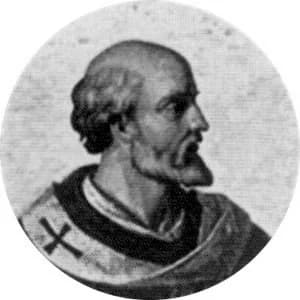
Sylvester II
Gerbert of Aurillac, who brought the abacus and the astrolabe north and was made pope by the emperor he had taught: the first French pope.
Pope no. 139999-1003
Gerbert of Aurillac was the most learned man in Latin Europe when Otto III made him pope, and he had been, in turn, a monk of the Auvergne, a student of Arabic mathematics in Catalonia, the master of the cathedral school of Reims, a failed abbot in Lombardy, an archbishop of Reims whom the pope refused to recognize, an archbishop of Ravenna whom the emperor imposed, and the tutor and friend of the young Otto himself. He took the name Sylvester because Sylvester I had been the pope of Constantine, and Otto, twenty years old and half Greek, meant to be a new Constantine ruling a renewed Roman empire from a palace on the Aventine. For two years pope and emperor governed together and drew the eastern edge of Latin Christendom: an archbishopric for Poland at Gniezno, an archbishopric for Hungary at Esztergom, a crown for Stephen. Then Rome rose, Otto died at twenty-one, and Sylvester came back to a city ruled by the Crescentii, who let him say Mass and write letters until he died in May 1003.
His pontificate was short and his reputation is long. He had taught Europe to count on an abacus with the nine Arabic numerals, to read the stars with an astrolabe, to build an organ and an armillary sphere, and to argue from Boethius; within a century the same learning had made him a magician in league with the devil, and the legend of the pope's pact was still being told when Otto's dream was a footnote. The scholar has outlasted the legend, and the emperor.
Aurillac and Catalonia
He was born about 945 in the Auvergne, of parents obscure enough that no one recorded them, and entered the monastery of Saint-Géraud at Aurillac as a boy. In 967 Count Borrell of Barcelona, passing through on pilgrimage, agreed to take the monastery's best pupil south to study under Bishop Atto of Vic, and for three years Gerbert lived on the frontier of Muslim Spain, where the mathematics and astronomy of Córdoba could be had in Latin translation at Vic and the monastery of Ripoll. In 970 Borrell and Atto took him to Rome; John XIII presented him to Otto I, who wanted a tutor for his son, and Gerbert, wanting logic, went instead to Reims to study under the archdeacon Gerannus. Archbishop Adalbero kept him. From 972 to 989 he ran the cathedral school of Reims and made it the best in the West.
The school of Reims
He taught the whole of the liberal arts, and the quadrivium as no one north of the Pyrenees had. For arithmetic he built a counting board with twenty-seven columns and a thousand horn counters marked with the nine numerals he had learned in Spain, the first use of Arabic figures in Latin Europe, and wrote the rules for multiplying and dividing on it. For astronomy he built spheres: a solid globe with the constellations, an armillary sphere with the circles of the heavens, a sighting tube for the pole star, and, from Arabic models, an astrolabe. For music he built an organ, and for geometry he wrote a treatise and taught the surveyors' methods. His letters beg friends everywhere for copies of Cicero, Boethius, Suetonius, and Pliny. At Ravenna in 980, before Otto II, he disputed with the Saxon schoolmaster Otric on the divisions of philosophy and won, and the emperor made him abbot of Bobbio in 983; the monks and the local lords defeated him within a year, and when Otto II died he went back to Reims.
Reims
The school made him a politician. As Adalbero's secretary he drafted the letters that helped bring Hugh Capet to the throne in 987 over the Carolingian claimant, and when Adalbero died in 989 he expected the see. Hugh gave it instead to Arnulf, the Carolingian's nephew, who promptly handed Reims to his uncle's army. A synod at Saint-Basle in June 991 deposed Arnulf for treason and elected Gerbert, and Gerbert wrote the synod's defense, which argued that a council of bishops could judge such a case without waiting on Rome. John XV disagreed. He sent a legate, suspended Gerbert at Mouzon in 995, and refused for the rest of his life to recognize him; Gerbert, unable to get the pallium and abandoned by Hugh's son, left Reims in 997 for the court of Otto III, who had already asked him to teach him. Gregory V reinstated Arnulf the next year. The archbishop who had defied a pope on the rights of councils was about to become one.
Otto's Rome
Otto III was sixteen when Gerbert joined him, the son of a Byzantine mother, crowned emperor at Rome the year before, and full of a program his tutor shared: the renewal of the Roman empire, renovatio imperii Romanorum, on his seal from 998. In April 998, after Otto had retaken Rome from Crescentius, Gerbert was made archbishop of Ravenna; in February 999 Gregory V died; and on 2 April 999 Gerbert was consecrated pope, the first Frenchman in the office, under a name chosen to match his emperor's.
Ours, ours is the Roman empire. Italy, fertile in fruits, Gaul and Germany, fertile in men, give their strength; nor do we lack the mighty kingdoms of the Scythians. Ours, Caesar, emperor of the Romans and Augustus, who are of Greek blood and surpass the Greeks in empire, who rule the Romans by right of inheritance and exceed both in genius and in eloquence.
They governed from the Aventine, where Otto built a palace and gave his officers Byzantine titles, and their work was the frontier. In March 1000 Otto went on pilgrimage to the tomb of his friend Adalbert of Prague at Gniezno, and there, with Sylvester's authority, the Polish duke Boleslaw received an archbishopric of his own with three suffragan sees, which took the church of Poland out of the hands of the German metropolitans for good. In the same year, or at its turn, Stephen of Hungary was crowned king and Esztergom became the archbishopric of the Hungarians.
In January 1001 Otto issued a diploma for the pope that gave the church eight counties of the Pentapolis and, in the same breath, called the Donation of Constantine a forgery by a cardinal deacon with mutilated fingers; the empire would endow the papacy, not be its gift. The Romans were not consulted about any of it. In February 1001 they rose, besieged the emperor in his palace, and forced him and the pope out of the city to Ravenna. Otto spent the year raising an army and died of fever at Paterno, north of Rome, on 24 January 1002, aged twenty-one, with Sylvester beside him.
The pact
Sylvester came back to Rome that year under John Crescentius, who governed as patrician and let the pope keep the Lateran and the pen. He held a synod, confirmed privileges, and wrote; he died on 12 May 1003 and was buried in the Lateran basilica, where his epitaph, composed for Sergius IV, still calls him the ornament of the world. Within a century the epitaph had competition.
He was a pope for four years and a teacher for thirty, and the teaching mattered more. The abacus he built was in use in the schools for two centuries; the students he trained taught Fulbert, whose students taught the eleventh century; the astrolabe he explained in Latin was the instrument Europe used to find its way for five hundred years. The empire he and Otto dreamed of lasted until the Romans threw them out of it. What Sylvester II had made at Reims, with a thousand horn counters and nine borrowed figures, lasted longer than anything he did in the Lateran, and he seems to have known it: the just man lives by faith, he had written from Reims, but it is good that he should join knowledge to his faith.
Sources
- J. N. D. Kelly and Michael Walsh, The Oxford Dictionary of Popes (2010)
- Eamon Duffy, Saints and Sinners: A History of the Popes (2014)
- Harriet Pratt Lattin (trans.), The Letters of Gerbert, with His Papal Privileges as Sylvester II (1961)
- Nancy Marie Brown, The Abacus and the Cross: The Story of the Pope Who Brought the Light of Science to the Dark Ages (2010)
- Chris Wickham, Medieval Rome: Stability and Crisis of a City, 900-1150 (2015)
- Philippe Levillain (ed.), The Papacy: An Encyclopedia (2002)
- Further reading: Wikipedia