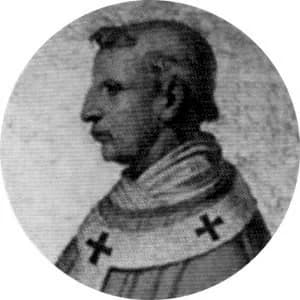
The Renaissance Papacy1447-1513
Nicholas V
The physician's son who ended the last schism, founded the Vatican Library, and decided Rome should be believed by being beautiful.
Pope no. 2081447-1455
Tommaso Parentucelli was a physician's son from Sarzana who had spent twenty years as the learned factotum of the saintly bishop of Bologna. He rose fast at the end: bishop of Bologna in 1444, cardinal in December 1446, pope on 6 March 1447. He inherited the tail of the Great Schism and finished it within two years, persuading the antipope Felix V to resign in April 1449 and the rump Council of Basel to dissolve itself, and he settled the church's relations with the Empire in the Concordat of Vienna of 1448. When he crowned Frederick III in Saint Peter's in March 1452 it was the last imperial coronation Rome would ever see.
What he did with the peace made him the founder of the Renaissance papacy. He set out to rebuild Rome as the visible capital of Christendom: aqueducts and walls repaired, the Vatican palace enlarged, Fra Angelico painting his private chapel, and Leon Battista Alberti and Bernardo Rossellino drawing plans for a new Saint Peter's to replace Constantine's crumbling basilica. He collected books with the passion of a scholar, employing Lorenzo Valla and a corps of translators to turn Greek into Latin, and the more than a thousand manuscripts he left became the Vatican Library. The Jubilee of 1450 filled the city and its treasury, and killed some two hundred pilgrims in a crush on the bridge to Castel Sant'Angelo.
The last years darkened. A republican conspiracy under Stefano Porcari nearly killed him in January 1453; the fall of Constantinople that May shook him more than any event of his life; and the bulls Dum diversas (1452) and Romanus Pontifex (1455), granting Portugal the right to conquer and enslave the peoples of West Africa, have made him a founding figure in the history of Atlantic slavery. He died on 24 March 1455, having made magnificence a policy.
A full essay on this pope is in preparation. The facts and summary above are complete and sourced.
Sources
- J. N. D. Kelly and Michael Walsh, The Oxford Dictionary of Popes (2010)
- Eamon Duffy, Saints and Sinners: A History of the Popes (2014)
- Charles L. Stinger, The Renaissance in Rome (1985)
- Further reading: Wikipedia