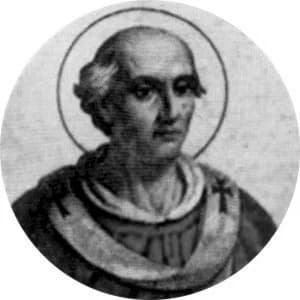
The Carolingian Papacy752-903
Saint Nicholas I
He deposed archbishops, refused a king his divorce, excommunicated a patriarch, and told the world the pope was judged by no one.
Pope no. 105858-867
Nicholas I was pope for nine years and behaved, for all of them, as if the papacy were already what the eleventh century would make it. He told the emperor Michael III that the see of Peter had authority over the whole church and that emperors had no business judging bishops. He deposed the patriarch of Constantinople, Photius, and was deposed by him in return. He deposed the archbishops of Cologne and Trier for annulling a king's marriage, refused the king, Lothair II, the divorce that would have given him a legitimate heir, and made him take back the wife he had accused of incest. He reinstated a bishop of Soissons whom the greatest archbishop in Francia had deposed, and cited in doing so a collection of papal letters forged a few years before, without knowing it. He answered a hundred and six questions from the newly baptized ruler of Bulgaria in a letter that told him to convert his people by persuasion and not the sword. A Frankish chronicler wrote when he died that he had commanded kings and tyrants as though he were lord of the world.
He did it from a Rome that could not defend itself, with a Frankish emperor at his elbow, and none of it held in his lifetime: Photius was restored, Lothair got no divorce but kept his mistress, Bulgaria went to the Greeks. What held was the claim. Every pope who later said that Rome judged all and was judged by none had Nicholas's letters to quote, and the medieval papacy is not intelligible without them.
The notary's son
He was born in Rome about 820, the son of Theodore, a notary of the papal administration, and grew up inside it: Sergius II made him subdeacon, Leo IV deacon, and Benedict III, whose restoration he had supported through the crisis of 855, kept him at his side. When Benedict died in April 858 the emperor Louis II was outside Rome and came in to see the election through. Nicholas was chosen on 24 April, consecrated in Saint Peter's with the emperor present, and dined with him at the Lateran, after which, the Liber Pontificalis says, Louis walked at the pope's bridle for the length of a bowshot. It was the last time a Carolingian did that for anyone. Nicholas's first notable act was to take back into the papal service Anastasius, the antipope of 855, who became his librarian and the drafter of his Greek correspondence; the most learned man in Rome had been an intruder three years before and would be indispensable for twenty.
Photius
In Constantinople the patriarch Ignatius, a monk and an emperor's son, had refused communion to the regent Bardas over an accusation of incest, and in November 858 he was deposed and replaced by Photius, the most learned layman in the empire, who was taken through the clerical grades in six days. Both parties wrote to Rome. Nicholas sent two legates, Radoald of Porto and Zachary of Anagni, to inquire, and at the council of 861 they did what the emperor wanted and confirmed Photius, in exchange for nothing at all. Nicholas repudiated them. At a Roman synod in 863 he deposed his own legates, declared Photius deposed, and pronounced Ignatius the lawful patriarch, on the ground that no one could remove a patriarch without Rome's consent and that Photius had been made bishop from a layman. Beneath the question of persons lay one of territory: Nicholas wanted the old Roman provinces of Illyricum and the new church of Bulgaria back from Constantinople, and said so in the same letters.
The emperor Michael III replied that Latin was a barbarous tongue. Nicholas's answer of 865, the longest letter of his reign, is the fullest statement of papal supremacy any pope had yet made: the privileges of the Roman church come from Christ, not from councils; the pope's judgment binds the whole church and can be revised by no one; emperors who are Christians are sons of the church and not its judges.
Since the days of the blessed Gregory no one raised to the papal dignity in the city of Rome has been his equal. He gave orders to kings and tyrants and ruled over them by his authority as though he were lord of the world.
Photius answered in kind. In the summer of 867 a council at Constantinople excommunicated and deposed Nicholas, and an encyclical to the eastern patriarchs condemned the Filioque and the Latin practices the pope's missionaries were introducing in Bulgaria, the first formal indictment of the Latin church by the Greek.
Lothair's marriage
Lothair II, king of the middle kingdom between France and Germany, had married Theutberga for her family's lands in 855 and wanted to marry Waldrada, who had borne him a son. He accused Theutberga of incest with her brother; she was cleared by ordeal, confessed under pressure, and was put in a convent; and in June 863 a synod at Metz, with two papal legates present, one of them the same Radoald, annulled the marriage and let the king marry Waldrada. The archbishops of Cologne and Trier, Gunthar and Theutgaud, carried the acts to Rome expecting confirmation. Nicholas quashed the synod, deposed both archbishops, and wrote to the bishops of Lotharingia that a king's marriage was not the king's to dissolve. Louis II marched on Rome in the archbishops' cause in February 864; his soldiers broke up a procession and threw its cross into the mud, and Nicholas took refuge in Saint Peter's and fasted for two days until the emperor, who had fallen ill, made his peace and left the archbishops to their fate. The next year the legate Arsenius of Orte forced Lothair to take Theutberga back, and Waldrada was excommunicated. When Theutberga herself, exhausted, asked the pope to let her be divorced, Nicholas refused her too. Lothair died in 869 with no legitimate heir, and his kingdom was divided between his uncles, which was the end of Lotharingia and, some have argued, the beginning of the rule that a Christian marriage is indissoluble whoever asks.
The decretals
The third quarrel was with the strongest churchman in the West. Hincmar of Reims had deposed Rothad, bishop of Soissons, at a provincial synod in 862, and Rothad appealed to Rome. Nicholas ordered him reinstated, on the ancient rule that a bishop's case could be judged finally only by the apostolic see, and when Hincmar stalled, the pope threatened to suspend him. Rothad came to Rome in 864 and was restored in 865, and he brought with him, in all probability, a book: the collection of papal letters known since as the pseudo-Isidorian decretals, forged in the province of Reims a decade earlier by clergy with grievances against their archbishops, and full of letters from the earliest popes asserting exactly the rights Nicholas was claiming. Nicholas cited the collection in Rothad's case and defended its authority when the Franks questioned it, and the popes went on citing it for seven hundred years.
He also brought John of Ravenna to heel, an archbishop who had governed his see as a prince and appealed to the emperor when the pope objected; John submitted in Rome in 861, and the church of Ravenna, which had claimed independence of Rome for two centuries, never claimed it again.
Bulgaria
Boris, khan of the Bulgars, was baptized in 864 under Byzantine pressure, asked Constantinople for a patriarch of his own, was refused, and in the summer of 866 sent envoys to Rome with a list of questions about how a Christian people should live. Nicholas's reply, dated 13 November 866, runs to a hundred and six answers and is the most attractive document of the reign. Yes, the Bulgars might go on wearing trousers. No, they should not fight on feast days if they could help it, nor punish apostates with death, nor torture suspects to make them confess, nor force the pagans to be baptized, since a faith imposed by the sword was no faith. He sent two bishops, Formosus of Porto and Paul of Populonia, to organize the church, and the Latin mission prospered for three years.
Boris wanted Formosus as his archbishop; Nicholas, who would not move a bishop from one see to another, refused, and after Nicholas's death Adrian II refused again. Boris went back to the Greeks in 870, and Bulgaria became the church of the Slavs under Constantinople. The pope who had asserted Rome's authority over the whole church had lost the one new people that asked for it.
Judged by none
Nicholas died on 13 November 867 and was buried in Saint Peter's. He is one of three popes called the Great, with Leo I and Gregory I, and a saint of the calendar on that day. He left about a hundred and fifty letters, and they were the harvest. Gratian put them in the Decretum in the twelfth century; Gregory VII had them read to him; the claim that the pope has the care of all the churches, that his judgment can be reviewed by no one, and that kings hold their thrones within the church and not above it, is his formulation before it was theirs. In his own time it was a claim made from a city the Saracens raided, by a pope who needed an emperor to walk at his bridle. Fifteen years after his death that emperor's successors would be unable to save Nicholas's own archdeacon, John VIII, from being murdered in the Lateran. The Carolingian papacy could say what Nicholas said. It could not yet enforce it.
Sources
- J. N. D. Kelly and Michael Walsh, The Oxford Dictionary of Popes (2010)
- Eamon Duffy, Saints and Sinners: A History of the Popes (2014)
- Raymond Davis (trans.), The Lives of the Ninth-Century Popes (Liber Pontificalis) (1995)
- Francis Dvornik, The Photian Schism: History and Legend (1948)
- Walter Ullmann, The Growth of Papal Government in the Middle Ages (1955)
- Peter Llewellyn, Rome in the Dark Ages (1971)
- Further reading: Wikipedia