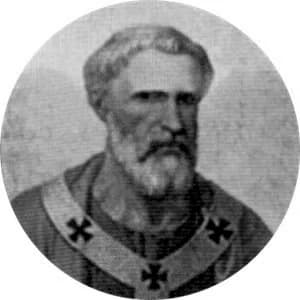
The Iron Century903-1046
Leo VII
Alberic's first pope, a Benedictine who brought Odo of Cluny to Rome to reform its monasteries and make its peace with a king.
Pope no. 126936-939
Leo was a Roman priest of San Sisto and probably a Benedictine monk, and he was Alberic II's choice to follow John XI, consecrated on 3 January 936. Alberic ruled the city; the pope's business was the church, and Leo's church was monastic. His first act was to invite Odo, abbot of Cluny, to Rome. Odo came three times in the next years, once to negotiate a peace between Alberic and Hugh of Provence, who had besieged the city to recover his wife and his position, and the marriage that sealed it, Alberic to Hugh's daughter Alda; and each time to reform. Leo made him archimandrite, superior of all the monasteries of Rome, and Odo restored the rule at Saint Paul's Outside the Walls, at Saint Mary's on the Aventine, which Alberic gave from his own palace, and at Subiaco and Farfa, where the monks had taken wives and an abbot had been poisoned.
To Germany he sent Frederick of Mainz as legate, with instructions to root out simony and clerical marriage, and in a letter that has been much quoted he answered Frederick's question about the Jews: the archbishop might expel them from his cities if they would not be baptized, but he must not baptize them by force. He died on 13 July 939 and was buried in Saint Peter's. Leo VII is the first pope of the century who can be said to have done the office's work, and he could do it because Alberic wanted a respectable pope and a reformed Rome, and had the soldiers to give him both.
A full essay on this pope is in preparation. The facts and summary above are complete and sourced.
Sources
- J. N. D. Kelly and Michael Walsh, The Oxford Dictionary of Popes (2010)
- Eamon Duffy, Saints and Sinners: A History of the Popes (2014)
- Chris Wickham, Medieval Rome: Stability and Crisis of a City, 900-1150 (2015)
- Peter Llewellyn, Rome in the Dark Ages (1971)
- Further reading: Wikipedia