The Iron Century903-1046
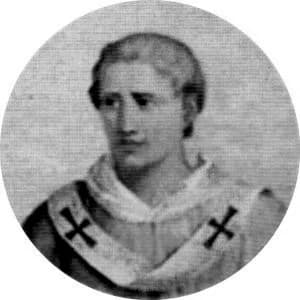
Leo V
A country priest elected in July 903 and in prison by September, the first victim of the century that followed.
Pope no. 118903
Leo was a priest from Priapi, a village in the territory of Ardea south of Rome, and not a Roman cleric at all, which makes his election in July 903, after Benedict IV's death, hard to explain. Auxilius, the contemporary defender of Formosus, calls him a man of good life, and a later catalogue says he ruled with the consent of all; perhaps he was a compromise between the Formosan and anti-Formosan parties that had torn the city apart for seven years, an outsider with no faction of his own. If so, he had no protectors either. About thirty days after his consecration the cardinal priest Christopher, one of his own household, seized the Lateran with armed men, threw Leo into prison, and had himself consecrated pope in September. Christopher held the see through the winter.
Leo V is a name and a date. He is remembered, when he is, because his fall set the pattern for the next hundred and forty years: a pope made by one faction and unmade by another, the Lateran taken by force, the loser dying out of sight. The one act attributed to him, a tax exemption for the canons of Bologna, is what a pope signs in his first month, and he had no second. He was buried, the catalogue says, in the Lateran, and Cathedra dates his death, with most references, to early 904.
A full essay on this pope is in preparation. The facts and summary above are complete and sourced.
Sources
- J. N. D. Kelly and Michael Walsh, The Oxford Dictionary of Popes (2010)
- Eamon Duffy, Saints and Sinners: A History of the Popes (2014)
- Peter Llewellyn, Rome in the Dark Ages (1971)
- Philippe Levillain (ed.), The Papacy: An Encyclopedia (2002)
- Further reading: Wikipedia