The Byzantine Papacy483-752
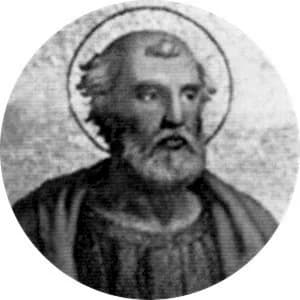
Saint Gelasius I
The Roman of African family who told an emperor there were two powers in the world, the priests' the weightier, and fed Rome as he said it.
Pope no. 49492-496
Gelasius reigned for four years and eight months and wrote, in that time, the sentence that Europe argued about for the next thousand years. It comes in a letter of 494 to the emperor Anastasius, who had asked why the bishop of Rome would not restore communion with Constantinople: there are two powers by which this world is ruled, the sacred authority of the bishops and the royal power, and of the two the bishops' is the heavier, because they will answer to God for the souls of kings. Popes cited it against emperors, emperors' lawyers cited it back, Gregory VII and Boniface VIII built on it, and the phrase "two powers" became the shorthand for the whole Western argument about church and state.
He was also, in his own city, a practical man in a bad time. Rome under Odoacer and then Theodoric was a Gothic capital with a Catholic bishop, short of grain and full of refugees, and Gelasius spent the church's income on feeding it. He fought the senate over a pagan festival, the Manichaeans over their books, and the Pelagians of Picenum over their sermons, and he wrote so many letters that more of his survive than of any pope before him. His deacon Dionysius Exiguus, who invented the Christian calendar, said that he had died poor after enriching the poor.
Felix's pen
He was born in Rome, he wrote, "Romanus natus," of an African family; the Liber Pontificalis calls him an African outright. Under Felix III he was the archdeacon who drafted the pope's letters, including the sentence of 484 against the patriarch Acacius that opened the schism with the East, and when Felix died on 1 March 492 he was elected the same day. The Roman clergy knew what they were choosing: the schism's author, promoted to keep it.
The Acacian question was the same one Felix had faced. Acacius was dead; his successors in Constantinople professed Chalcedon in private and kept his name on the diptychs in public, because the emperor Zeno's Henotikon had made silence about Chalcedon the price of peace with the Monophysite East. Gelasius would not have silence. Acacius's name must go, he told Constantinople, and until it did, no communion. The Eastern bishops replied that Rome was excommunicating a whole church over a dead man; Gelasius replied that a church which honored a heretic shared his heresy. Neither side moved. The schism outlived him by twenty-three years.
Two powers
The emperor Anastasius, who had succeeded Zeno in 491 and inclined toward the Monophysites, complained that the pope had not even informed him of his election. Gelasius wrote back in 494, and the letter is the one that matters.
There are two powers, august Emperor, by which this world is chiefly ruled: the sacred authority of the priests and the royal power. Of these the priests' burden is the heavier, since they must render account at the divine judgment even for the kings of men.
The argument goes on: the emperor rules in public affairs and the bishops obey him there, but in the things of God the emperor must bow his head to the bishops, and above all to the bishop of "that see which the Most High wished to be set above all others." It was not a claim to rule the empire. It was a claim that there were two orders of authority, that neither absorbed the other, and that in matters of religion the ranking was the reverse of the one the emperors assumed. Gelasius set it out again in a treatise on the anathema, where he argued that Christ had separated the two offices that pagan emperors had combined in the title pontifex maximus, so that "Christian emperors should need priests for eternal life, and priests should use imperial regulations for the course of temporal affairs."
The Lupercalia
The same year, Gelasius fought a pagan festival. Every February the Lupercalia still sent young men running half-naked through the streets of Rome striking women with thongs of goatskin, a fertility rite older than the Republic, and the Christian senators who paid for it argued that abolishing it had brought plague. The senator Andromachus defended it in writing. Gelasius answered in a treatise that survives, telling the senators that if they believed in the rite they should run in it themselves rather than hiring the poor to do it, that a Christian who kept pagan protections was neither one thing nor the other, and that the plague had other causes. Whether the running stopped that year is not recorded; it is not heard of again.
Bread and order
Rome in the 490s was hungry. The Vandals held Africa and its grain, the Goths held the north, and the city's population had fallen to a fraction of its imperial size. Gelasius, the Liber Pontificalis says, "delivered the city from the danger of famine," and his letters show how: he drew on the church's estates in Sicily and southern Italy, sold plate, and organized distribution through the deacons. He also fixed the rule for how the church's income was to be divided, a quarter each to the bishop, the clergy, the buildings, and the poor, a formula that Simplicius had stated and Gelasius made standard for the Italian sees under Rome.
Order meant discipline too. He required the bishops of Italy to ordain only men of good record, at fixed seasons, after fixed intervals; he insisted that communion be received in both kinds, because the Manichaeans refused the wine and it was a way of finding them; he had the Manichaeans' books burned in front of Santa Maria Maggiore; he reproved the bishops of Picenum for letting Pelagian teaching revive; and he told the bishops of Dardania, on the frontier of the schism, that the Roman church's authority over them came "not from synodal decisions but from the voice of the Lord."
What was his and what was not
His name was attached, over the next centuries, to two documents he did not write. The Gelasian Sacramentary, a Roman liturgical book of the seventh century, was credited to him because a synod in his time was believed to have regulated the Mass; the Gelasian Decree, a sixth-century list of the canonical scriptures and of approved and forbidden books, borrowed his name and Damasus's for authority. He did compose prayers, and his contemporaries praised his style; but the papacy's habit of reading its later achievements back into its great names began early, and Gelasius was its first beneficiary.
What was his was the letter, the famine relief, the discipline, and a title. A Roman synod of 495, restoring the legate Misenus whom Felix had deposed, addressed Gelasius as "Vicar of Christ," the first time the phrase is recorded of a pope; the ninth century would take it up, and Innocent III would make it the office's own. He died on 21 November 496, was buried in Saint Peter's, and is kept as a saint on that day. Dionysius Exiguus's epitaph for him is the one a pope of the Byzantine age might have wanted: that he had been "more concerned to be a servant than to be a lord."
Sources
- J. N. D. Kelly and Michael Walsh, The Oxford Dictionary of Popes (2010)
- Eamon Duffy, Saints and Sinners: A History of the Popes (2014)
- Gelasius I, Letter to the Emperor Anastasius (Duo sunt) (494) · link
- Jeffrey Richards, The Popes and the Papacy in the Early Middle Ages, 476-752 (1979)
- Raymond Davis (trans.), The Book of Pontiffs (Liber Pontificalis) (2000)
- Further reading: Wikipedia