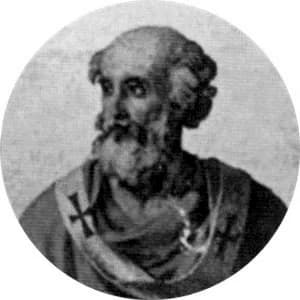
The Byzantine Papacy483-752
Boniface III
Nine months in 607, in which a usurping emperor declared Rome the head of all the churches and a synod forbade talk of the succession.
Pope no. 66607
Boniface, a Roman whose father had the Greek name Cataadioce, had been Gregory the Great's envoy in Constantinople in 603, where he had made himself agreeable to the new emperor Phocas, the centurion who had murdered Maurice and his sons. That friendship explains both his election, in the year the see waited on Phocas's pleasure, and the reign's one recorded act. He was consecrated on 19 February 607, and at some point in the months that followed Phocas issued a decree, known only from the Liber Pontificalis, that "the see of Blessed Peter the Apostle should be the head of all the churches," and that the title of universal bishop belonged to the bishop of Rome alone, a rebuke to the patriarchs of Constantinople who had been calling themselves ecumenical since John the Faster.
Boniface also held a synod of seventy-two bishops that forbade anyone, on pain of excommunication, to discuss the succession during a pope's lifetime or for three days after his burial, a rule aimed at the canvassing that had preceded his own election and that would be broken at nearly every election after. He died on 12 November 607 and was buried in Saint Peter's. Phocas's column, the last monument ever raised in the Roman Forum, went up in the same year to honor the emperor who had made Rome head of the churches, and it still stands there, alone.
A full essay on this pope is in preparation. The facts and summary above are complete and sourced.
Sources
- J. N. D. Kelly and Michael Walsh, The Oxford Dictionary of Popes (2010)
- Jeffrey Richards, The Popes and the Papacy in the Early Middle Ages, 476-752 (1979)
- Raymond Davis (trans.), The Book of Pontiffs (Liber Pontificalis) (2000)
- Further reading: Wikipedia