The Age of Persecution99-311
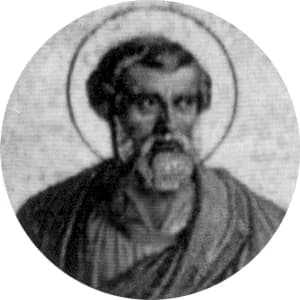
Saint Anterus
Forty-three days in the chair during Maximinus's purge, and the first pope laid in the papal crypt on the Appian Way.
Pope no. 19235-236
Anterus was elected on 21 November 235, eight weeks after Pontian's abdication, with the bishop and the antipope both in the Sardinian mines and the emperor Maximinus still hunting the leaders of the church. A Greek, the son of a Romulus according to the Liber Pontificalis, he held the office for forty-three days and died on 3 January 236. Eusebius gives him a month; the Liberian Catalogue gives the exact dates; nothing gives a reason for his death.
His burial is better attested than his life. He was the first bishop of Rome laid in the new papal crypt of the catacomb of Callixtus, the chamber Zephyrinus and Callixtus had prepared on the Appian Way, and his Greek epitaph, "Anteros, bishop," cut into the marble slab that sealed his shelf, was found there by Giovanni Battista de Rossi in 1854, the earliest surviving inscription of a pope in his own tomb. Pontian, whose body Fabian brought home from Sardinia the next year, was placed beside him. Eight more popes would follow in the same room over the next fifty years, and the crypt became, in the excavator's phrase, the little Vatican of the third century.
Anterus's feast, 3 January, keeps the date of his death. Of the man himself, the Greek name, the six weeks, and the shelf in the crypt are everything.
A full essay on this pope is in preparation. The facts and summary above are complete and sourced.